Even if you’re not a hard-core fan of the Women’s National Basketball Association, you may have heard of the Caitlin Clark Effect. The hypothesis is that Caitlin Clark, the first pick in the 2024 WNBA draft by the Indiana Fever, is the cause of the unprecedented increase in league attendance, attributable to her extraordinary talent and charisma.
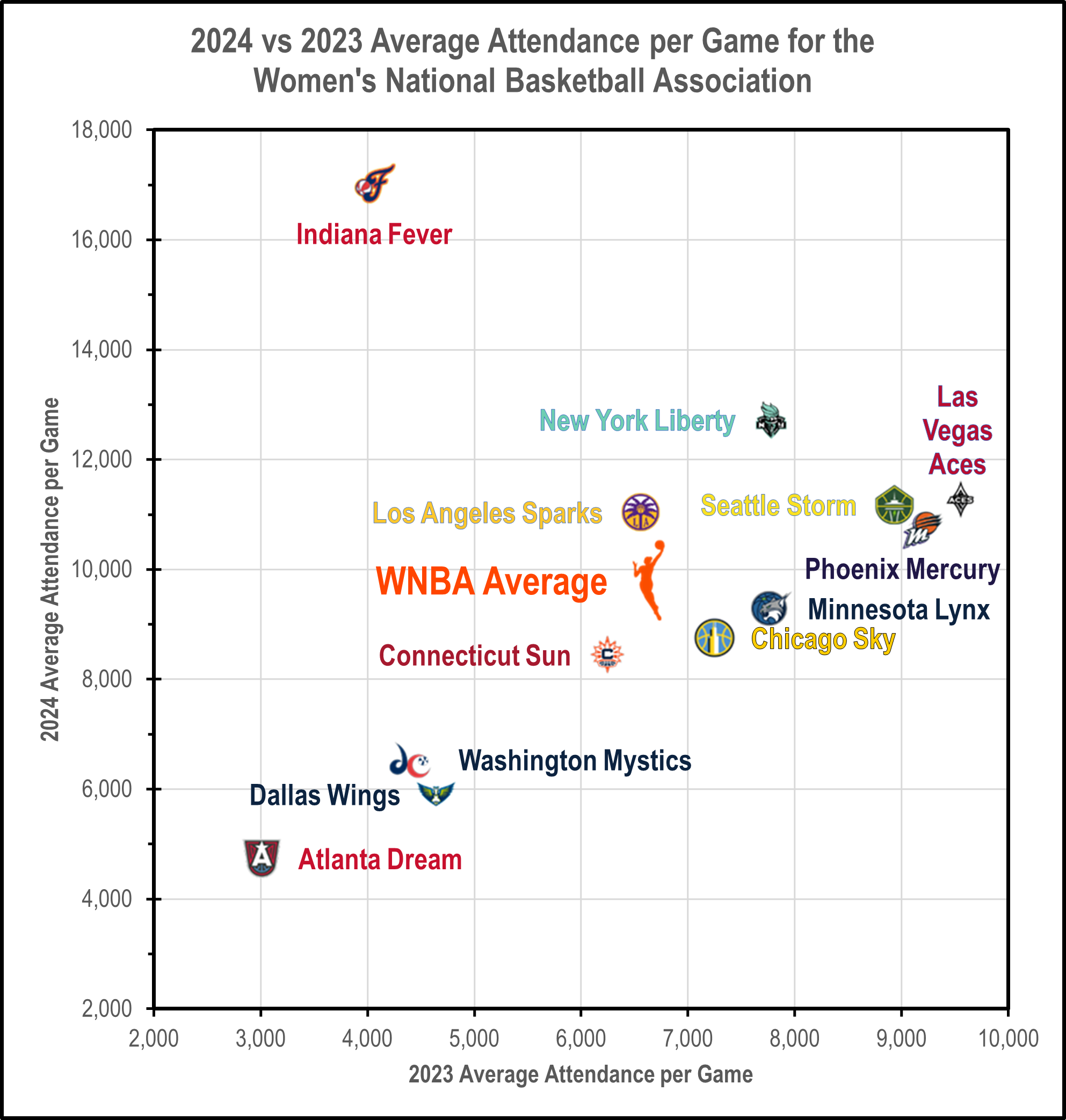
This scatterplot shows the average attendance per game during the 2023 and 2024 seasons for the 12 teams in the WNBA. The plot shows that overall attendance at WNBA games increased by 48% from 2023 to 2024, with most of the teams seeing 16% to 68% more fans.
The Indiana Fever were a MAJOR outlier to this trend, however. They had a 319% increase in attendance from 2023 to 2024, which is why the team’s attendance plots in the upper left corner of the graph far away from the rest of the teams. They went from the low end of team attendance in 2023 to the highest in 2024.
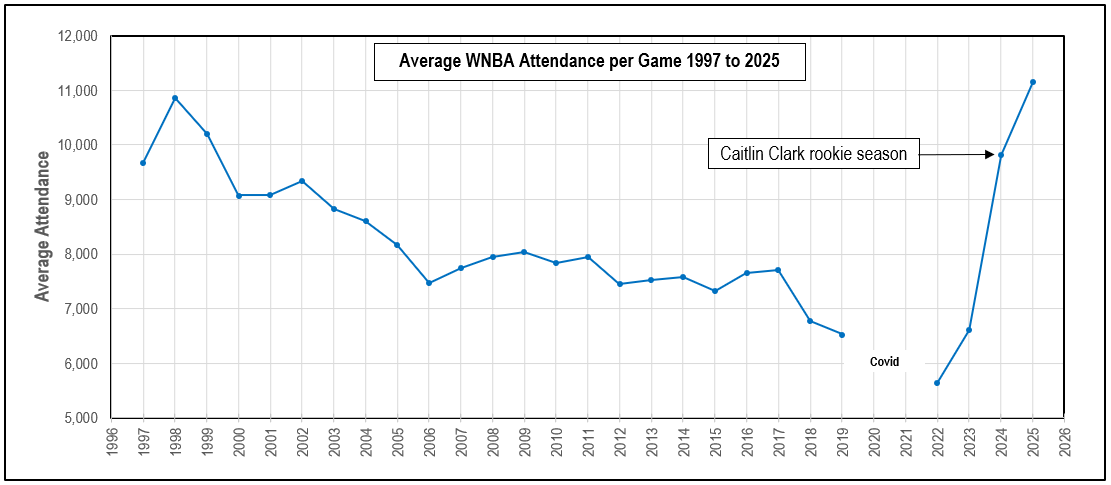
The effect is even more impressive considering the entire history of league attendance at over 6,000 games from 1997 to 2025. Attendance had dropped from about 10,000 attendees per game before 2000 to about 6,000 just before Clark was drafted. That’s a loss of about 160 attendees per league game averaged over 24 seasons. It doesn’t sound like much, but it adds up. It’s like a slow oil leak from your car. You keep seeing a few drops of oil on the garage floor and before long, your check-engine light comes on. After Caitlin Clark was drafted, average attendance increased by 5,000 attendees per game by 2025. That’s what’s called Caitlin Clark Effect, but is she the cause of it?
One widely cited set of criteria used to evaluate causality was described in 1965 by Austin Bradford Hill, a British medical statistician. His nine criteria are
- Strength. A relationship is more likely to be causal if the correlation coefficient is large and statistically significant.
- Specificity. A relationship is more likely to be causal if there is no other likely explanation.
- Temporality. A relationship is more likely to be causal if the effect always occurs after the cause.
- Gradient. A relationship is more likely to be causal if a greater exposure to the suspected cause leads to a greater effect.
- Plausibility. A relationship is more likely to be causal if there is a plausible mechanism linking the cause and the effect.
- Coherence. A relationship is more likely to be causal if it is compatible with related facts and theories.
- Analogy. A relationship is more likely to be causal if there are proven relationships between similar causes and effects.
- Consistency. A relationship is more likely to be causal if it can be replicated.
- Experiment. A relationship is more likely to be causal if it can be verified experimentally.
Hill’s criteria were established for experimental studies. For observational studies, the Consistency and Experiment criteria do not apply.
Evidence that Caitlin Clark is the cause of the great increases in WNBA attendance includes:
- Temporality is supported by the great increases in average game attendance, as shown in the graphs.
- Gradient is supported by the continued and increased attendance even after her rookie WNBA season.
- Coherence is supported by similar increases in merchandise sales for Clark and other players in the WNBA.
- Analogy is supported by similar increases in attendance for other notable players in sports, like Michael Jordan, Pelé, Walter Payton, Tiger Woods, Wayne Gretzky, and many others.
- Specificity is supported by her team, the Indiana Fever, having by far the largest increase in attendance despite the introduction of new players to other teams from the 2024 draft.
- Plausibility is supported by the great interest Clark drew in college basketball at Iowa.
Ironically, the strength of the correlation in the data, the criterion most people associate with causality, isn’t a factor. In fact, it is the opposite. Clark’s presence is an outlier to the trend in historical attendance. So, while correlation does not always imply causation, causation does not always imply correlation.
While no individual criterion is foolproof, causality is more convincing when many of Hill’s criteria are met. Yet despite these observations, there are still people who do not believe that Caitlin Clark is the cause of the increase in WNBA attendance. What do you think?
Read more about data relationships and causation in Chapter 7 of Stats with Kittens.